
Affiliate Disclaimer: This post may contain affiliate links. As an affiliate, I may earn a commission if you purchase through my links, at no extra cost to you. Please read our full disclosure for more info.
Short answer:
No — you do not need to curate other people’s pins or follow people to get followers or traffic on Pinterest. Pinterest growth comes almost entirely from Pinterest SEO, not social engagement.
Curating others’ pins and following people has minimal to zero impact on distribution, according to all current 2026 sources.
What You’ll Learn
- Why Pinterest growth doesn’t depend on following people
- Why curating other creators’ pins doesn’t increase your reach
- How Pinterest actually distributes content in 2026
- What actions do matter for traffic and visibility
- Evidence‑based insights from current Pinterest‑focused sources
- Beginner‑safe steps you can apply immediately
Myth Breakdown
Myth:
“You need to follow people and save other creators’ pins to grow on Pinterest.”
Truth:
Pinterest does not reward social actions.
It rewards search relevance, keywords, and fresh content.
Following people and curating others’ pins has no measurable impact on your reach or traffic.
How Pinterest Growth Actually Works
Pinterest is a visual search engine, not a social platform. Your reach comes from keywords, relevance, and fresh content, not from following people or curating their pins.
Pinterest’s algorithm distributes your content based on how well your pin matches what users are searching for — not who you interact with.
Current sources consistently show that:
- Pinterest ranks pins individually based on keywords + engagement signals
- Your follower count has minimal influence on distribution
- Saving other people’s pins does not boost your authority
- Following people does not increase your reach
- Your visibility comes from search, home feed recommendations, and related pins
Pinterest behaves much closer to Google Images than Instagram or TikTok.
Once beginners understand this, the platform becomes dramatically easier to use.
Do You Need to Curate Other People’s Pins?
Short answer: No.
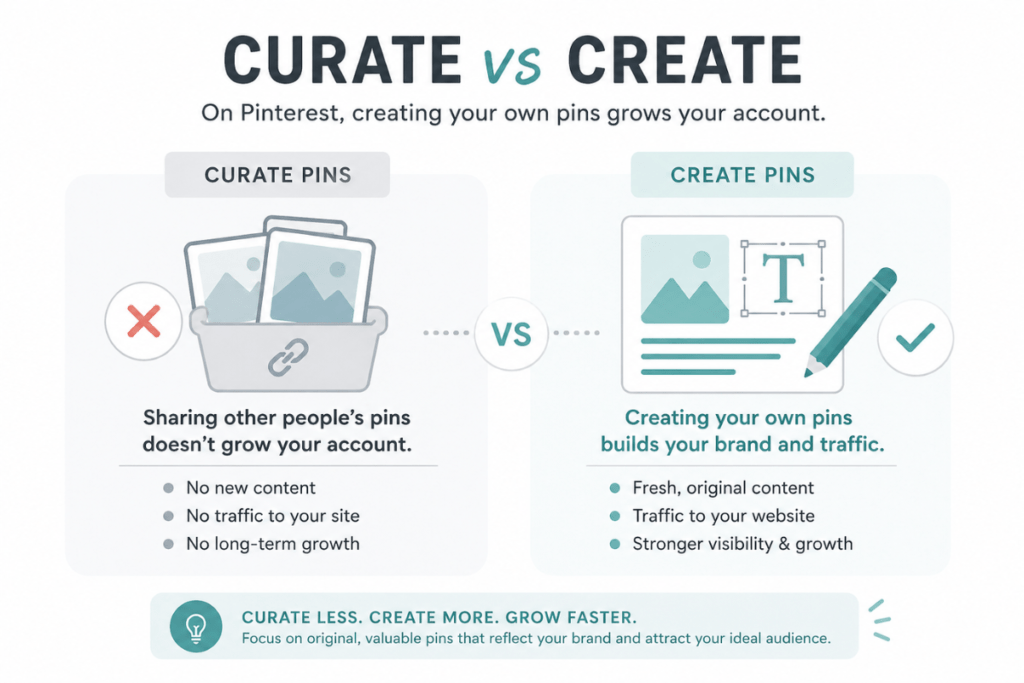
Saving other creators’ pins does not boost your reach, authority, or distribution on Pinterest.
Pinterest does not treat curation as a ranking signal. It does not “reward” you for saving other people’s content, and it does not increase the visibility of your own pins.
Here’s what actually happens:
- Saving others’ pins is a personal organization action, not a growth action
- Pinterest does not give your account “credit” for curating
- Your boards do not gain authority from other people’s content
- Your distribution does not increase when you save more pins
- Your traffic does not grow from curation activity
When curation is useful
- To organize your own ideas
- To research your niche
- To understand what high‑performing pins look like
- To save inspiration for your own content creation
But in terms of growth, reach, and traffic — curation does nothing.
Do You Need to Follow People to Get Followers?
Short answer: No.
Following people does not increase your reach, visibility, or follower count on Pinterest.
Pinterest does not operate on a “follow‑for‑follow” or social‑graph model like Instagram or TikTok.
Your content is distributed based on keywords, relevance, and pin performance, not your social activity.
Here’s what the data and platform behavior show:
- Your follower count does not determine how many people see your pins
- Following others does not boost your distribution
- Pinterest does not reward “engagement loops” or social reciprocity
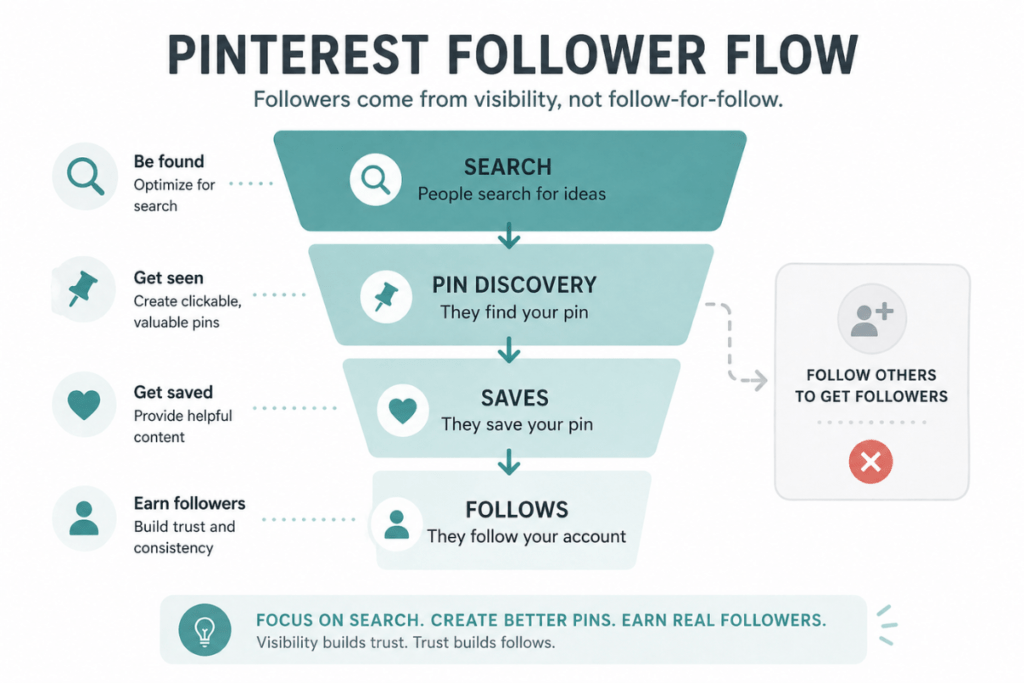
- Most of your impressions come from search, not followers
- People follow you after discovering your pins in search results
Where followers actually come from
- Your pins ranking in search
- Your pins appearing in home feed recommendations
- Your pins showing up in “More like this”
- Your pins being saved by others (this increases exposure)
Followers on Pinterest are a by‑product of visibility, not the cause of it.
What Actually Grows Traffic on Pinterest
Pinterest rewards relevance, fresh content, and search alignment.
The platform pushes your pins when they match what users are actively searching for and when your content consistently proves useful.
Here are the real growth levers:
- Keyword‑aligned pin titles and descriptions
Pinterest needs clear signals to understand what your pin is about. - Fresh pins published consistently
New images give Pinterest more opportunities to test your content in search. - Clear, readable pin designs
High contrast, simple layouts, and fast comprehension increase saves and clicks. - Strong alignment between pin → text → landing page
Pinterest boosts content that stays on‑topic from start to finish. - High‑intent topics
Content that solves real problems or answers real questions performs best. - User saves
When people save your pins, Pinterest interprets it as a quality signal and expands distribution.
Action Steps to Grow on Pinterest (Beginner‑Safe)
These are the practical steps beginners can follow to grow without relying on social actions like following or curating:
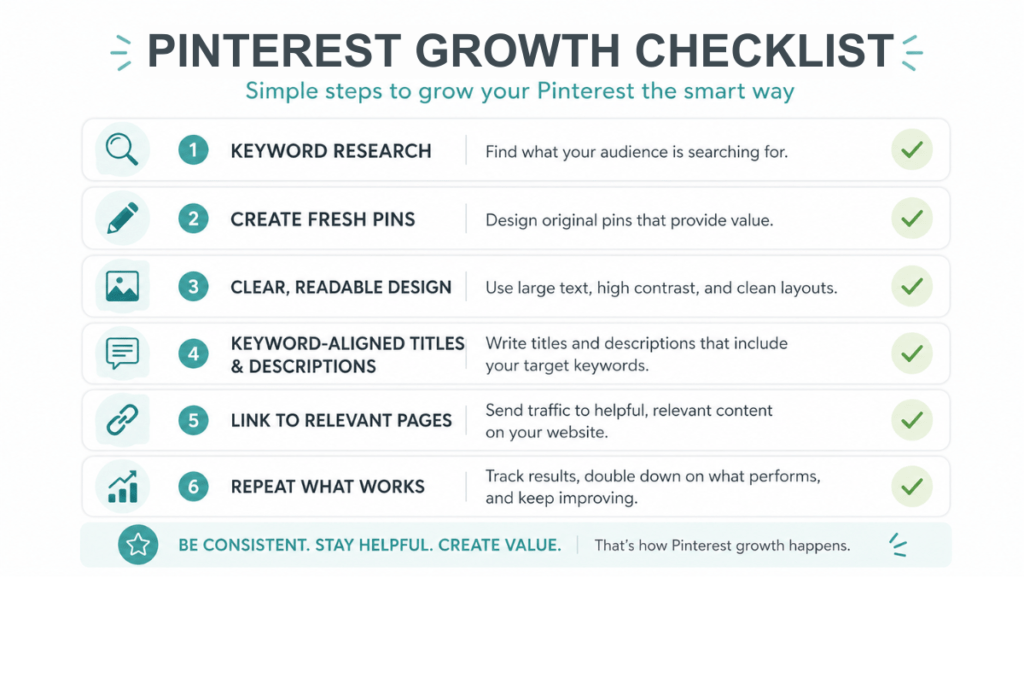
- Identify 5–10 keywords your audience searches for
Use Pinterest’s search bar, auto‑suggestions, and related searches to understand real user intent.
Learn the full process here: How to Find Pinterest Keywords - Create fresh pins for your own content consistently
Each new pin gives Pinterest another chance to test your content in search results. - Use clear, readable designs with strong contrast
Your pin must communicate the topic instantly to earn saves and clicks.
Follow the full design guide here: Pinterest Pin Design Guide - Write keyword‑aligned titles and descriptions
Match the exact phrasing your audience uses so Pinterest can categorize your pin correctly. - Link to a relevant landing page
Pinterest rewards alignment between the pin, the text, and the destination. - Repeat what works
When a pin gains traction, create more variations targeting the same keyword cluster.
What to Expect When You Start Applying These Steps
Most beginners assume Pinterest growth is instant, but the platform works on a testing cycle. Pinterest needs time to understand your content, categorize it, and match it to the right searches. When you follow the action steps consistently, here’s what typically happens:
- Weeks 1–4:
Pinterest tests your new pins in small batches. Impressions may look low, but this is normal. The system is learning your niche, your keywords, and your content style. - Weeks 4–8:
Your pins begin appearing in more relevant searches. Saves start increasing. Some pins will outperform others — these are your early indicators of what your audience wants. - Months 2–4:
Your top‑performing pins stabilize in search results. Traffic becomes more consistent. You’ll see clear patterns in which topics and designs drive the most engagement. - Months 4–6:
Your account gains authority in your niche. Pinterest begins distributing your content faster and more widely. Growth becomes more predictable and easier to scale.
This is the natural Pinterest growth curve — slow at the start, then compounding as the system learns your content.
Common Mistakes to Avoid
Most beginners struggle on Pinterest not because their niche is too small or their account is too new, but because they unknowingly send the wrong signals to the algorithm.
Avoiding these mistakes helps Pinterest understand your content faster and distribute it more accurately.
1. Using vague or generic titles
Titles like “Tips You Need to Know” or “My Favorite Ideas” give Pinterest nothing to work with. Always use clear, keyword‑aligned titles that match real search intent.
2. Designing pins that are hard to read
Low contrast, tiny text, busy backgrounds, or overly decorative fonts reduce saves and clicks. Pinterest favors pins that communicate the topic instantly.
3. Posting without keyword research
If your pins don’t match what people are searching for, they won’t appear in search results. Keyword alignment is the foundation of Pinterest growth.
4. Linking to irrelevant or weak landing pages
If the pin promises one thing but the page delivers something else, Pinterest reduces distribution. Relevance from pin → text → page is critical.
5. Expecting instant results
Pinterest is a search engine, not a social feed. It needs time to test and categorize your content. Slow early impressions are normal.
6. Chasing trends outside your niche
Trending topics may get temporary impressions, but they don’t build long‑term authority. Stick to your niche so Pinterest can understand your account.
Final Thoughts
Pinterest growth isn’t about social actions, trends, or hacks — it’s about creating content that aligns with what people are actively searching for.
When you focus on keywords, clarity, relevance, and consistency, Pinterest begins to understand your niche and distribute your content to the right audience.
The early phase may feel slow, but every pin you publish strengthens your account and builds long‑term search visibility.
Stay consistent, stay aligned with your niche, and let Pinterest’s search engine do the heavy lifting over time.
Ready to Grow Your Pinterest Traffic?
If you’re serious about building long‑term, search‑driven traffic, start with the steps in this guide and stay consistent.
Pinterest rewards creators who publish helpful, keyword‑aligned content — and the sooner you begin, the sooner the platform can start learning your niche.
If you want deeper guidance, check out these next steps:
- Learn how to find the right keywords for your niche
How to Find Pinterest Keywords - Improve your pin designs for higher saves and clicks
Pinterest Pin Design Guide
Small, consistent actions compound. Start today, and let Pinterest work for you over time.