
Affiliate Disclaimer: This post may contain affiliate links. As an affiliate, I may earn a commission if you purchase through my links, at no extra cost to you. Please read our full disclosure for more info.
You’ve decided to start a blog. You’ve got your folder system organized. You know Pinterest is the traffic strategy that makes sense for beginners.
But now you’re stuck on the one question that paralyzes almost every new blogger:
“What should I actually blog about?”
You’ve probably spent hours scrolling through “profitable niche” lists, watching YouTube videos about the “best blog topics for this year,” and second-guessing every idea that pops into your head.
What if no one cares about this topic?
What if the niche is too competitive?
What if I pick the wrong thing and waste months of work?
I get it. I’ve been there. I spent years jumping between ideas, terrified of committing to the “wrong” niche, watching other bloggers move forward while I stayed stuck in analysis paralysis.
Here’s what I finally learned: The “perfect” niche doesn’t exist. But the right niche for you absolutely does.
And the good news? You don’t need a complicated 47-step validation process to find it. You just need a simple framework that removes the guesswork and gets you moving.
In this post, I’m walking you through exactly how to choose a profitable blog niche without overthinking it. You’ll know what to look for, how to validate demand, and how to make a confident decision you won’t regret six months from now.
Let’s get you unstuck.
What Is a Blog Niche (And Why Does It Actually Matter)?
A blog niche is the specific topic or category your blog focuses on. It’s not just “lifestyle” or “wellness”—it’s the narrowed-down slice of a bigger topic that you own.
Examples:
- Too broad: Health
Better niche: Meal prep for busy parents - Too broad: Travel
Better niche: Solo budget travel for women over 40 - Too broad: Personal finance
Better niche: Paying off student debt in your 30s
Notice the pattern? A good niche is specific enough to attract a clear audience, but broad enough to give you room to create content without running out of ideas in three months.
What You’ll Learn
- The “Profitability Triangle”: How to find the sweet spot between what you love, what you’re good at, and what actually makes money.
- Validation via Pinterest & AI: How to use real-time search data to prove your niche has a hungry audience before you buy a domain.
- Why “Niche Down” is a Trap: How to choose a topic broad enough for 100+ posts so you never hit a wall in month six.
- The Competitor Audit: A simple 10-minute trick to find “gaps” in your niche that other bloggers are ignoring.
- The 24-Hour Commitment Rule: How to stop overthinking and start building, even if you aren’t 100% sure yet.
This niche-selection strategy is Phase 1 of our Start Here: How to Start a Blog for Beginners (Step-by-Step Roadmap).
Why Your Niche Matters (Even If You Don’t Care About SEO)
Even if you’re using Pinterest for traffic instead of Google, your niche still matters. Here’s why:
1. Pinterest users want clarity. They’re not browsing your “about” page—they’re looking at one pin and deciding in 3 seconds if your blog can solve their problem. A clear niche = instant trust.
2. You need enough content ideas to stay consistent. If your niche is too narrow, you’ll burn out. If it’s too broad, you’ll confuse your audience (and yourself).
3. Monetization depends on focus. Affiliate programs, digital products, and course partnerships work better when you’re serving a specific audience with a clear problem.
If you picked “wellness tips” as your niche, what would you even promote? A fitness tracker? A meditation app? A meal planning course? Your audience won’t know what to expect, and neither will you.
But if your niche is “stress relief for working moms,” suddenly everything gets clearer. Your pins, your posts, your affiliate offers—they all align.
That’s the power of a well-chosen niche.
The 3-Circle Framework: Where Passion, Expertise, and Profit Meet
Forget those 100-question niche quizzes. You don’t need a personality test to choose a blog niche. You need three simple circles—and the magic happens where they overlap.
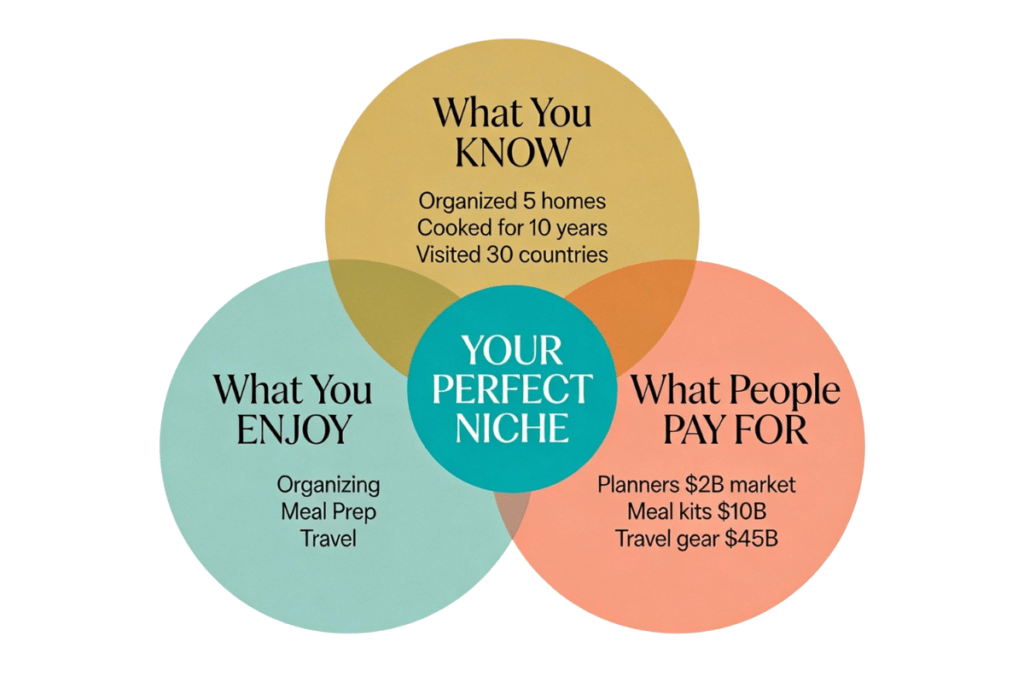
Circle 1: What You Actually Enjoy Talking About
This isn’t about “follow your passion and the money will come” advice. It’s practical.
You’re going to write 50+ blog posts in your first year. You’re going to create pins, respond to comments, and research your topic constantly. If you pick a niche solely because “it’s profitable” but you hate the topic, you’ll quit.
Ask yourself:
- What do friends and family ask me for advice about?
- What topics do I find myself reading about in my free time?
- If I had to write 10 blog post titles right now, what would they be about?
If you can’t come up with at least 20-30 post ideas without Googling, the niche probably isn’t for you.
Examples:
- You love organizing and systems → productivity, time management, home organization
- You’ve struggled with (and overcome) something specific → debt payoff, postpartum fitness, career changes
- You’re deep into a hobby → meal prepping, budget travel, DIY home projects
Circle 2: What You Know Enough About to Be Helpful
You don’t need to be the world’s #1 expert. You just need to know more than the person who’s searching for help on Pinterest.
This could be:
- Professional knowledge: You’re a teacher, nurse, graphic designer, accountant
- Personal experience: You’ve lost 50 pounds, paid off $30K in debt, moved abroad
- Hobby-level expertise: You’ve been meal prepping for 3 years, you’ve renovated two homes, you’ve traveled to 15 countries on a budget
The key is this: Can you teach someone how to get from Point A to Point B?
If yes, you have enough expertise.
Don’t let imposter syndrome talk you out of this. The people searching “how to start meal prepping” don’t need a nutritionist—they need someone who’s been doing it successfully for a while and can explain it simply.
Circle 3: What People Will Actually Pay For
This is where a lot of beginner bloggers get stuck. They pick a niche they love, with expertise to share, but there’s no clear way to make money.
A profitable niche has:
- Products or services people already buy (meal planning apps, budgeting tools, travel gear, productivity planners)
- Affiliate programs with decent commissions (20%+ is ideal)
- Pain points that drive urgency (debt stress, health fears, time scarcity, career uncertainty)
To test profitability:
- Google “[your niche] + affiliate programs”—if you find 5-10 programs, that’s a green flag.
- Search Pinterest for your niche—if there are thousands of pins getting saved, people care about this topic.
- Check Amazon for related products—if there’s a category with bestsellers, there’s demand.
Red flag niches (hard to monetize):
- Hobbies with no products (cloud watching, people watching, daydreaming)
- Niches where people expect everything free (most “inspirational quotes” blogs)
- Topics with very low purchasing power (extreme frugality tips, how to live on $0)
Green flag niches (easier to monetize):
- Health and wellness (fitness, mental health, nutrition)
- Personal finance (budgeting, debt payoff, investing)
- Productivity and organization (time management, home organization, planners)
- Parenting (activities, tips, product recommendations)
- Food (meal prep, recipes, kitchen organization)
The sweet spot? The overlap of all three circles.
You enjoy it + You know it + People will pay for solutions = Your profitable blog niche.
How to Validate Your Niche (Without Spending a Dime)
You’ve got a niche idea. Now, before you commit, let’s make sure it’s actually worth pursuing.
This is where most “niche validation guides” get overwhelming. They tell you to buy expensive keyword tools, analyze 47 competitors, and build out a 6-month content calendar before you write a single post.
Ignore that.
Here’s the beginner-friendly validation process that actually works:
Step 1: The Google Trends Test
Open Google Trends (it’s free) and type in your niche topic.
What you’re looking for:
- Stable or rising interest over the past 5 years (not a sharp decline)
- Consistent search volume (not just one random spike)
Example:
- “Meal prep” → Steady interest over time ✅
- “Fidget spinners” → Massive spike in 2017, dead now ❌
If your niche shows declining interest, that’s not necessarily a dealbreaker—but it means you’ll be working harder to attract an audience.
Step 2: The Pinterest Search Test
Go to Pinterest and search for your niche topic. Look at:
- How many pins show up (thousands = healthy interest)
- Engagement on pins (saves, comments)
- Variety of content (if it’s all the same 5 bloggers, that’s a red flag)
If Pinterest is flooded with pins on your topic, that’s proof people are searching for it.
But here’s the key: Competition isn’t bad. It’s confirmation.
If no one is creating content in your niche, it’s not because you found a “hidden gem”—it’s because there’s no audience.
Step 3: The Affiliate Program Test
Search “[your niche] + affiliate programs” on Google.
If you find at least 5-10 programs offering 15-20%+ commissions, you’re in good shape.
Examples:
- Budgeting niche: YNAB, EveryDollar, Mint (all have affiliate programs)
- Meal prep niche: HelloFresh, meal planning apps, kitchen tools on Amazon
- Productivity niche: Notion, Asana, productivity planners
No affiliate programs? That’s not a dealbreaker if you plan to sell your own products (like a course or templates). But it makes monetization harder in the beginning.
Step 4: The “Can I Write 50 Posts?” Test
Open a Google Doc and start brainstorming blog post titles.
If you can come up with at least 30-50 post ideas in 20 minutes, you’re good. If you’re struggling to hit 10, your niche might be too narrow.

AI Assistance: Stuck on Finding a Niche?
If the 3-Circle Framework feels overwhelming, use this AI prompt to get unstuck in 2 minutes.
Copy-Paste this into Google Gemini or Perplexity:
I want to start a blog but I'm stuck on choosing a niche.

**My Interests:** [List 3 hobbies/interests, e.g., organizing, yoga, budget travel]
**My Experience:** [List what you're good at, e.g., teacher, paid off debt, mom of 3]
**My Goal:** I want to monetize with affiliate marketing and eventually digital products.

Please analyze the overlap between my interests and experience. Suggest 3 profitable niche ideas that work for a beginner blogger. For each idea, list:
1. The specific target audience
2. 3 products I could promote as an affiliate
3. 5 blog post titles to start with

Tell me which one has the highest potential for Pinterest traffic.
Why this works: Instead of staring at the blank page, you give AI your raw material (interests + experience) and it does the heavy lifting of matching them to profitable opportunities.
Common Niche Mistakes (And How to Avoid Them)
Let’s talk about the traps I see beginner bloggers fall into over and over again.
Mistake #1: Going Too Broad
“I want to blog about lifestyle.”
Okay, but what does that even mean? Travel? Productivity? Relationships? Fashion? Recipes?
When your niche is too broad, you confuse your audience. They don’t know what to expect, so they don’t follow you.
Fix: Niche down one more level.
- Lifestyle → Productivity for working parents
- Food → Meal prep for beginners on a budget
- Wellness → Stress relief for teachers
Mistake #2: Going Too Narrow
“I want to blog about gluten-free vegan desserts for people with nut allergies.”
That’s… really specific. Maybe too specific.
If your niche is so narrow that you can only write 10 blog posts before running out of ideas, you’ll hit a wall fast.
Fix: Zoom out slightly.
- Gluten-free vegan desserts for people with nut allergies → Allergy-friendly baking
- Budget travel to Southeast Asia → Budget travel tips for beginners
Mistake #3: Picking a Niche Just Because It’s “Profitable”
If you hate personal finance, don’t start a finance blog just because “it makes money.”
You’ll burn out in 3 months.
Fix: Pick something at the intersection of interest + profitability. If nothing overlaps, rethink your list.
Mistake #4: Waiting for the “Perfect” Niche
Here’s the truth: You won’t know if your niche is perfect until you actually start.
The best validation comes from real readers, real traffic, and real feedback. You can’t get that sitting in research mode for 6 months.
Fix: Pick the best option on your shortlist and commit to 20 posts. If it’s not working after that, you can pivot. But you have to start somewhere.
Final Decision: 3 Questions to Lock In Your Niche
You’ve done the research. You’ve validated the idea. Now it’s time to choose.
Ask yourself these three questions:
1. Can I write 50+ blog posts on this topic without getting bored?
If the answer is no, pick a broader niche or a different topic.
2. Can I clearly explain who this blog is for in one sentence?
Example: “I help working moms simplify meal planning so they can stop stressing about dinner.”
If you can’t fill in that sentence, your niche isn’t clear enough.
3. Am I excited to start creating content for this audience?
If you’re not excited now, you definitely won’t be excited in 6 months when the newness wears off.
If you answered yes to all three, you’ve found your niche.
Stop second-guessing. Start building.
What’s Next: From Niche to Content Plan
Now that you’ve chosen your niche, the next step is keyword research—but not the traditional SEO kind.
You need to figure out what your audience is actually searching for on Pinterest so you can create content that drives traffic from day one.
That’s exactly what we’re covering in the next post: How to Find Pinterest Keywords That Actually Drive Traffic (Free Methods).
You’ll learn how to use Pinterest’s search bar, Google autocomplete, and free tools to build a keyword list that powers your entire content strategy—no expensive tools required.
Ready to Turn Your Blog Into a Real Business?
Choosing your niche is just the beginning. If you want a proven system that takes you from niche selection to consistent traffic and income, check out Sophia Lee’s Beginner Blogging Course.
It’s the exact roadmap I followed to go from confused beginner to confident blogger—and it’s designed specifically for people who want results without the overwhelm.